
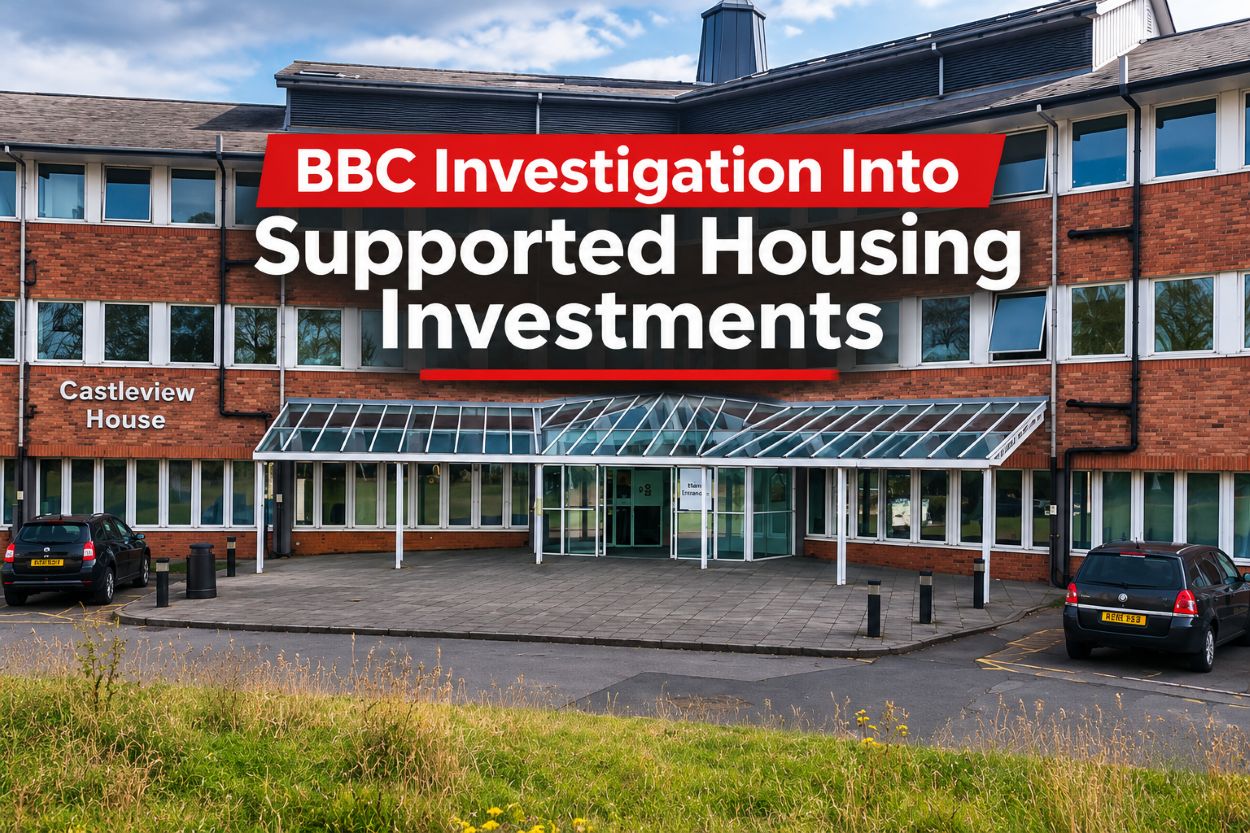
We wish we could say today’s BBC investigation came as a surprise. It didn’t. For several years, North Fox has been warning investors to be extremely cautious about supported living and assisted housing investments promising double-digit yields, 20 or 25-year rental agreements and supposedly “government-backed” income. We have been warning investors about this model as far back as 2023. Following the Sunday Times investigation in January 2025 we felt we should write our own piece and we returned to the subject in April 2026 and wrote about it again following a BBC Panorama investigation last month.
Our 2025 assisted-living articleThe Dangers of Supported Living InvestmentsOur October 2026 BBC supported-living article
Today’s BBC investigation gives investors even more reason to understand exactly what they are buying.
What Has the BBC Found?
The BBC investigated properties being marketed in the UK and overseas as secure, ethical investments generating income from supported housing. It identified more than 40 companies marketing this type of property to investors across a number of countries. One example involved Castleview House in Runcorn. The BBC reported that an overseas investor paid £163,150 for a flat when similar apartments in the building were available for around £75,000. Meanwhile, residents described problems including black mould, rats and poor conditions. The BBC also reported concerns from some tenants about the level of support they were receiving. That valuation point should make every property investor stop and think. If the lease and promised income disappeared tomorrow, what would the property actually be worth? If you are paying £160,000 for an asset worth £75,000 on the normal residential market, you are not simply buying property. You are potentially paying an enormous premium for a contract and the organisation standing behind it.
“Government-Backed” Does Not Mean Government-Guaranteed
This is something we have repeatedly warned about. The fact that rental income ultimately originates from housing benefit or another public funding mechanism does not necessarily mean the Government guarantees the investor’s rent. At Castleview House, the BBC reported that some flats had been leased to Nurture Housing Association under 25-year arrangements and that marketing used the regular cash flow and public funding behind the model to promote the properties to investors. Nurture told the BBC that Castleview House operates under a general housing management model and is not part of its supported housing portfolio. It also said that it was not directly involved with companies marketing the properties and that it would remind relevant agents to ensure information concerning Nurture was accurate and did not create misunderstanding. That distinction matters enormously. A 25-year agreement sounds impressive. But a contract is ultimately only as strong as the organisation required to honour it.
This Is Not a Niche Corner of the Property Industry
Supported housing investment has been promoted extensively by established UK property investment agencies. To be absolutely clear, we are not suggesting that any of these agents has acted unlawfully or that the BBC has accused them of doing so. The BBC article does not make that allegation. We mention them because it demonstrates how mainstream this investment model has become — and why investors should never assume that an opportunity is low-risk simply because it is being offered by a well-established property company.
Investor Concerns Are Also Appearing Online
There is another development we think investors should be aware of. Recent public discussions online have included allegations from investors about missing or delayed expected payments involving Nurture-linked supported-housing investments. A dedicated Facebook investor-recovery group is also being promoted through those discussions. We have not independently verified those individual claims, and they should therefore be treated as investor allegations rather than established fact. However, the existence of organised investor discussions itself reinforces why anyone involved in these investments should be checking their contractual position carefully rather than simply relying on the words “assured”, “guaranteed” or “government-backed”.
Our Position Hasn’t Changed
We believe supported housing provides an important service and that there are undoubtedly responsible organisations operating within the sector. But that is very different from saying that supported-living property sold to private investors at high prices with double-digit “assured” returns is a safe investment. We don’t believe it is. In our view, many of these investments can expose buyers to a combination of inflated property values, operator risk, funding risk, regulatory risk, restricted resale markets and reliance on one organisation continuing to honour a long-term contract. The higher the promised return, the harder investors should look at what is creating that return. A 10%, 11% or 12% return isn’t magic. You are being paid to take risk. The important question is whether you actually understand what that risk is.
Worried About an Investment — Or Thinking About Buying One?
Here are the practical steps we would take:
- Already invested and worried: gather your purchase contract, lease or management agreement, original brochure, emails, payment statements and anything describing the income as “guaranteed”, “assured” or “government-backed”. Keep copies rather than relying on web pages remaining online.
- Check whether payments are up to date. If anything is late or missing, ask the housing provider, developer and selling agent for a written explanation rather than relying on telephone assurances.
- Get independent legal advice. Ideally use a solicitor experienced in property disputes and complex lease arrangements who was not involved in the original sale.
- Obtain an independent RICS valuation. Ask what the property is worth on the normal open market without the supported-housing agreement attached. This tells you how much of your capital is really property value and how much depends on the contract.
- Understand exactly who owes you the rent. Is it the Government, a council, a housing association, a CIC, a management company or another business? Then check that entity’s financial position, regulatory status and accounts.
- Read the exit provisions carefully. Check break clauses, assignment restrictions, termination provisions and what happens if the housing provider or operator stops trading.
- If you are considering buying: do all of the above before exchanging contracts, not afterwards. Do not rely solely on a developer valuation, recommended solicitor or projected yield supplied by the selling agent.
- Finally, apply one simple test: if the operator disappeared tomorrow, would you still be happy owning the property at the price you paid? If the answer is no, you need to understand that you are taking much more than ordinary property risk.
Final Thought
Today’s BBC investigation is uncomfortable reading, but from an investment perspective the underlying lesson is remarkably simple. Don’t mistake publicly funded rent for a government guarantee. Don’t mistake a 25-year agreement for 25 years of certainty. And don’t mistake a double-digit yield for a low-risk investment. We have been warning about these issues for years because we believe investors deserve to hear about the downside as well as the sales pitch. If someone is offering you an apparently effortless 10–12% return for the next 25 years, perhaps the most important question isn’t: “How much will I make?” It’s: “What has to keep going right for me to actually receive that return?”