


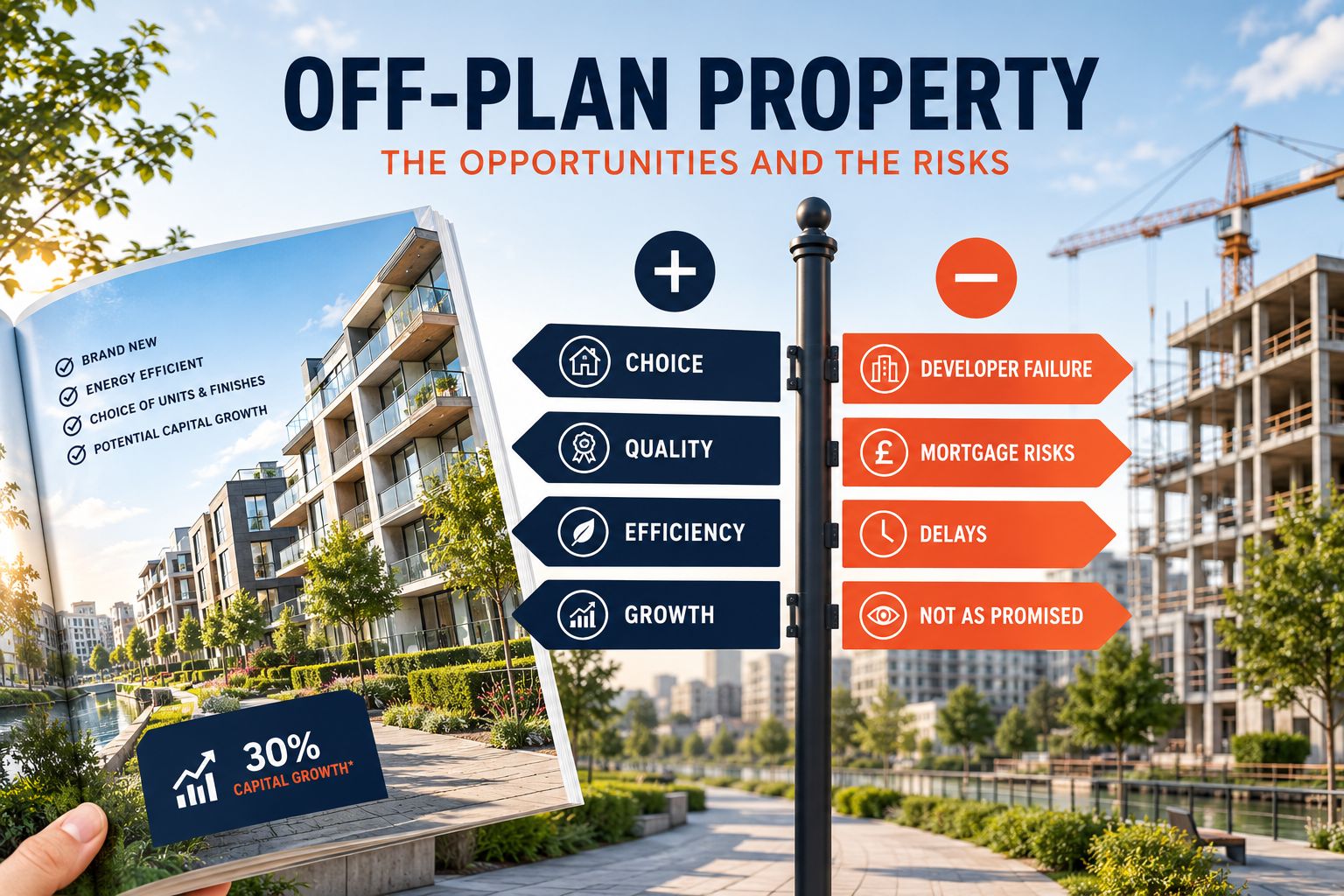
If you’ve recently started looking for an investment property, you’ve probably done what most people do – opened Google or had a scroll through social media. Before long you’ll be surrounded by adverts for the latest off-plan development. The message is usually the same: “Buy today at tomorrow’s price,” “Early investor discounts,” “Luxury apartments,” and “Exceptional capital growth.” It all sounds very tempting.
Brand-new properties are attractive to tenants, they’re energy efficient, often require very little maintenance in the early years and buyers usually get the pick of the best plots and layouts before construction is complete.
However, there is another side to the story.
One thing we’ve noticed more and more is that many investors we speak to simply aren’t aware of the risks involved. That’s hardly surprising because they just don’t seem to be discussed a great deal, for a pretty obvious reason (people want you to buy). Most marketing focuses entirely on the potential upside.
As with any investment, understanding the downside is just as if not more important.
The Advantages of Buying Off-Plan
Let’s start with the positives because there are plenty.
Brand-New Property
Everything is new.
That means:
- Lower maintenance costs in the early years
- Fewer unexpected repair bills
- Modern layouts that appeal to today’s tenants
Better Energy Efficiency
New-build homes are significantly more energy efficient than older housing stock.
Higher EPC ratings generally mean:
- Lower energy bills
- Greater appeal to tenants
- Less risk of future energy efficiency legislation affecting the property
Choice of Plot and Specification
Buying early often allows investors to choose:
- Better positions within the development
- Preferred floor plans
- Parking spaces
- Views
- Optional upgrades and finishes
Sometimes these choices can improve resale appeal in the future.
Potential Capital Growth During Construction
If the market performs well while the property is being built, buyers may benefit from capital appreciation before they even complete.
However—and this is important—that isn’t guaranteed.
Which brings us neatly onto the risks.
Risk 1 – Developer Insolvency
This is without doubt the biggest risk, yet it’s one of the least talked about.
When you buy off-plan, you’re placing enormous trust in the developer.
If they experience financial difficulties during construction:
- Work may stop completely
- Completion dates may slip indefinitely
- Buyers could face lengthy legal processes
- Deposits will almost certainly be at risk unless you are buying from a plc developer.
While most reputable developers complete their schemes successfully, history shows that developer failures do happen regularly (we have unfortunately experienced this first hand)—particularly when borrowing costs rise or the housing market slows.
A 20% deposit on a £250,000 apartment represents £50,000.
That’s a significant amount of money to have tied up in a project that may not finish on time—or at all.
Risk 2 – Mortgage Down-Valuations
Many investors assume that because they’ve agreed to buy at a certain price, the bank will automatically agree.
Unfortunately, that’s not how it works.
Your lender will carry out its own valuation when the property is ready to complete.
If the valuer believes the property is worth less than you agreed to pay, you could receive a lower mortgage offer—or, in some cases, no mortgage offer at all.
This means you may suddenly need to find tens of thousands of pounds in additional cash to complete the purchase.
Risk 3 – Construction Delays
Very few major developments complete exactly on schedule.
Delays can be caused by:
- Labour shortages
- Material costs
- Planning issues
- Weather
- Supply chain problems
- Contractor disputes
While a few months’ delay may not sound significant, it can have knock-on effects.
Mortgage offers may expire.
Your circumstances may change.
Interest rates may increase.
Rental income is delayed.
In some cases we’ve seen projects delayed by several years.
Risk 4 – The Finished Product Doesn’t Match the Brochure
One of the biggest challenges with buying off-plan is that you’re purchasing something that doesn’t yet exist.
Developments are usually marketed using:
- Beautiful CGI images
- Professionally staged show apartments
- Lifestyle photography
- Ambitious growth forecasts
The finished development can be very different.
Perhaps:
- The quality isn’t quite what you expected.
- The communal areas feel smaller.
- The surrounding area isn’t as attractive.
- Views have changed.
- The specification has been altered.
None of these issues necessarily make the investment bad—but expectations and reality don’t always align.
Risk 5 – Markets Can Change
Buying off-plan usually means waiting between one and three years before completion.
That’s a long time.
During that period:
- Interest rates can rise.
- Governments can change tax rules.
- Lending criteria can tighten.
- Rental demand can evolve.
- House prices can move in either direction.
You’re effectively making today’s investment decision based on what you believe the market will look like in several years’ time.
So Should You Avoid Off-Plan?
Not necessarily.
Some of our investors have achieved excellent returns from buying off-plan.
The key is understanding exactly what you’re buying and carrying out proper due diligence before committing.
Questions worth asking include:
- Is the developer financially strong?
- Is my deposit protected?
- What happens if completion is delayed?
- What comparable properties have actually sold for?
- Am I paying today’s market value—or tomorrow’s projected value?
- Would I still be happy owning this property if prices didn’t rise?
Our View
At North Fox, we’re not against off-plan property at all, we often sell it ourselves.
We simply believe investors need to understand both the advantages and the risks before making a decision.
Off-plan can absolutely work—but it requires a greater degree of trust, patience and risk tolerance.
As with any investment, the best decisions are informed decisions.
Final Thoughts
The most successful investors aren’t usually the ones chasing the newest development, the slickest marketing campaign or the promise of extraordinary returns.
They’re the ones who take a measured approach, understand exactly what they’re buying and focus on quality over hype. Rather than looking for shortcuts, they build wealth gradually by making good decisions, protecting their capital and allowing their investments to grow and compound over time.
Property investment isn’t a sprint—it’s a marathon. And more often than not, the winners are those who stay disciplined, ignore the noise and stick to the fundamentals.


